
Getting to know the EYE better to better understand your vision
The eye can be compared to a camera. Its anterior segment is made up of two natural lenses: the cornea, located in front of the iris, and the crystalline lens, located behind it.
- The iris, which gives the eye its distinct color, acts like a diaphragm by controlling the amount of light that enters the eye through the pupil (the black central part). When there is a large amount of light, the pupil contracts; in lower light, it dilates.
- The cornea is a curved transparent window. Its curvature gives it a certain focusing power, comparable to a camera lens.
- The crystalline lens is a transparent, flexible lens at birth. It is enclosed in a membrane called the capsule, which is attached to muscles. When these muscles contract, the crystalline lens becomes more rounded, much like a magnifying glass. This action, called accommodation, allows the eye to adjust its focus when an object moves closer. This adjustment mimics the zoom function of a camera.

Vision Problems
Learn more about how the eye works and about common vision problems.
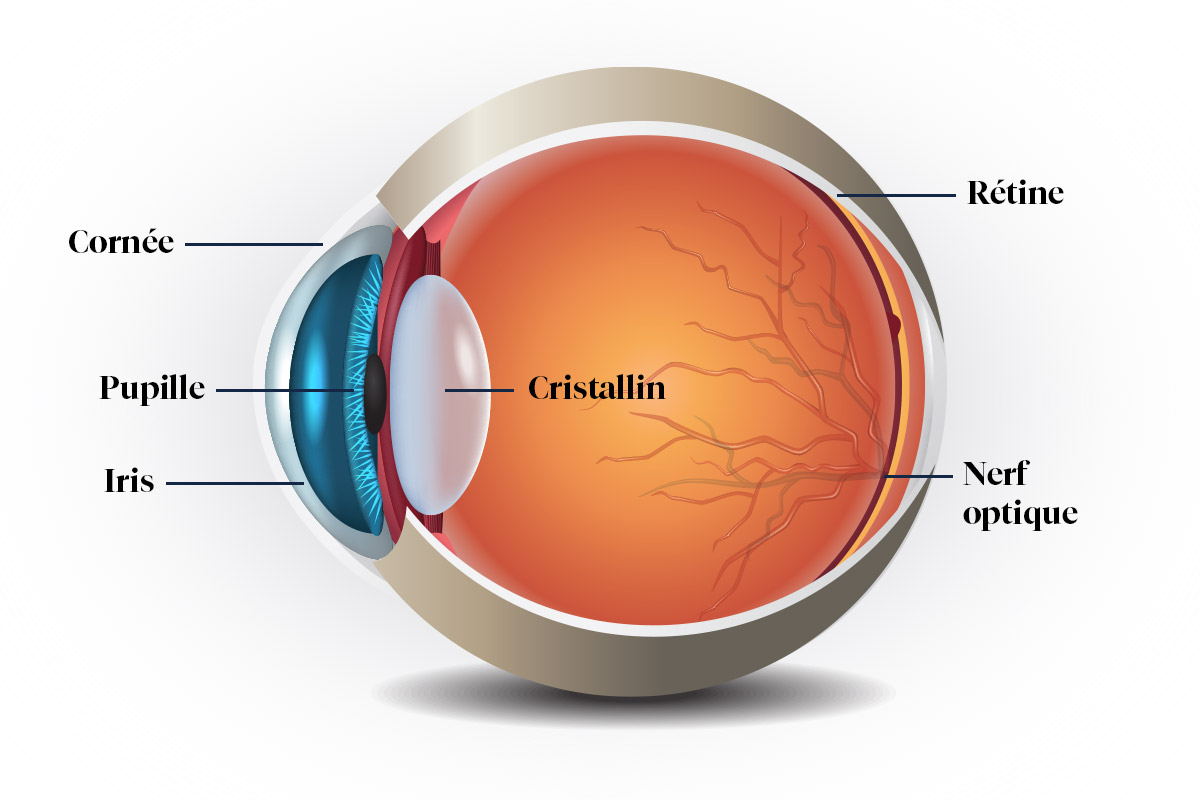
As light rays pass through the cornea and then the crystalline lens, they converge at a focal point. After passing through a gel-like substance called the vitreous, all of these points of light form an image that is captured by the retina. The retina lines the back of the eye much like the film in a camera.
The image is then transmitted to the brain as nerve impulses through the optic nerve.
The 4 Vision Problems

Myopia
Myopia is a very common vision problem. A person with myopia can see clearly up close, but objects in the distance appear blurry without glasses. It is the most common vision disorder.

Hyperopia
Hyperopia is a visual condition that allows for clear distance vision, but causes near vision to appear blurry.

Astigmatism
Astigmatism is a common vision problem often caused by an irregular shape of the cornea or the crystalline lens. This visual disorder can create uneven blurriness around an object or the impression of double vision. Depending on the case, this blurred vision may affect both near and distance vision.

Presbyopia
Presbyopia is caused by the age-related loss of the crystalline lens’s natural ability to accommodate.
Do you have questions about eye surgery?
Our patient care coordination team will be happy to answer your questions. Contact us at 1.877.656.4747.
